Investing Made Simple: Investing In Index Funds Explained In 100 Pages Or Less Pdf Download

Our number 1 goal at DollarSprout is to aid readers improve their financial lives, and nosotros regularly partner with companies that share that same vision. If a purchase or signup is made through one of our Partners' links, we may receive bounty for the referral. Learn more here.
This "Investing for Beginners" Guide will walk you through, step past step, how to kickoff investing without feeling completely overwhelmed.
Do you lot want your money to earn you more coin?
Well, it tin't do its piece of work hiding in a bank account.
Whether you lot want to save for your child's higher or prepare for retirement, you'll achieve your goal faster by investing.
Hither's everything you need to know to get started today.
What Is Investing?
When you lot invest, y'all purchase something with the expectation of profiting off of it in the future.
In the 1990s, some people idea they were making smart "investments" in Beanie Babies and McDonald's toys. But traditional investments include things similar buying in a business, existent estate assets, or lending money to a person or company in exchange for interest payments.
Why Should I Invest?
Merely saving money isn't enough to build wealth. A bank will go on your money rubber. But, each year, inflation makes every dollar you've tucked away slightly less valuable. So, a dollar you put in the depository financial institution today is worth just a little less tomorrow.
Comparatively, when you invest, your dollars are working to earn you more than dollars. And those new dollars work to earn you even more dollars. The snowballing strength of growth is known as compound growth.
Over the long term, investing allows your avails to abound over and above the rate of aggrandizement. Your by savings build on themselves, instead of declining in value as the years pass. This makes it significantly easier to save for long-term goals like retirement.
When Should I Beginning Investing?
Yesterday. But if you lot oasis't started yet, today is a groovy 2d choice.
In full general, you want to start investing equally presently every bit you accept a solid financial base in place. This includes having no loftier-interest debt, an emergency fund in place, and a goal for your investments in mind. Doing and then allows you to leave your money invested for the long-term – cardinal for maximum growth – and be confident in your investment choices through the natural ups and downs of the market.
Benefits of starting young
Compound growth requires time. The earlier you start investing, the more wealth you tin can create with fewer dollars.
When it comes to investing, time is your about powerful tool. The longer your money is invested, the longer it has to piece of work to create more coin and have reward of compound growth. It likewise makes it far less likely that one harsh market downturn volition negatively impact your wealth equally you'll accept time to leave the money invested and recover its value.
Let'due south look at an example:
Since 1928, the average render of the S&P 500 (a gear up of 500 of the largest public companies in the U.Southward. that is oftentimes used to judge the stock market) is about ten%.
So, let's say you're 25 and put $v,000 in the South&P 500. You meet a 10% increment in value each year, letting your money keep to grow. When you turn 65, you lot open your account to discover you accept over $226,000. An excellent retirement gift to yourself!
Even so, if you waited until yous were 35 to start investing, your value at 65 would only exist $87,000. Notwithstanding impressive, but fewer than half of what y'all would accept had if you started a decade earlier.
Pay off loftier-interest debt first
View paying down high-interest debt every bit investing until you no longer have those debts. Every dollar toward master earns you an instant return by eliminating future interest cost.
If you still accept high-interest debt, such as credit cards or personal loans, you should hold off on investing. Your coin works harder for you lot by eliminating that pesky involvement expense than it does in the market. This is because paying off $1 of debt balance saves yous 12%, xiv%, or more in future involvement expense. More than traditional investments tin be expected to return.
Focus on getting out of debt every bit fast as you lot can, then dive into investing.
Have an emergency fund in place
To reduce the risk of having to pull money out of your investments early on, have an emergency fund to protect from life'southward unexpected twists and turns.
Remember how nosotros said time is the near powerful tool? To start investing, you lot accept to be set up up to let that coin stay invested. Otherwise, yous limit your time horizon and could force yourself to withdraw your coin at the incorrect time.
To protect yourself from unexpected expenses or job layoffs, save a sufficient emergency fund for your needs. Do non program for your investment accounts to be a regular source of cash.
Starting small is OK
Sometimes people think they can't showtime investing until they have a significant amount of money. Simply this means many people requite up years of compound growth waiting until they feel rich enough. No matter how pocket-size, get your money working for you lot as before long equally possible.
Consider our previous example of the $five,000 invested at 25- or 35-years-old. Pretend for a moment the 35-year-one-time didn't take $five,000 to invest at age 25, only she did take $500. And she thought, mayhap, she could scrape together $50 a calendar month to add to her $500 investment.
If she invested $500 at age 25, and then $fifty a month until she had put away a full of $5,000, she would accept almost $174,000 at retirement age. That is double what she would have had if she waited until she had $5,000 at age 35.
Starting small makes a significant difference, especially if information technology ways yous arrive the market sooner.
Investing 101: Basic Investing Terms
The number one thing that scares off new investors is the jargon. The investment market place has a ton of jargon. And so, we're going to requite you the inside scoop to go far less intimidating.
What is a stock?
A stock, also known as a "share," is a tiny ownership pale in a business concern. Public companies permit anyone to buy or sell ownership shares of their business on exchanges.
If yous own a stock, yous are actually a role owner of the company. Go yous! While owning a share of Walmart won't requite you the power to fire the dull cashier at your local store, you lot exercise take some rights. You can, for instance, vote on members of the Lath of Directors.
What is a bond?
A bond is debt of a corporation, municipality, or country.
By purchasing a bond, you are loaning coin to ane of these entities. For companies, bonds are typically segmented into $i,000 increments that pay interest every six months, with the full value paid back at "maturity," i.e., the date the debt is due. Government bonds are typically known as "treasuries."
What is a portfolio?
A portfolio is a collection of all your investments held by a particular broker or investment provider. Y'all may ain some private stocks, bonds, or ETFs. Everything in your account would be your portfolio.
However, your portfolio can also mean all your investments across all account types, as this gives a ameliorate picture of your entire exposure.
What does diversification mean?
Just like you wouldn't invest all your money in your friend's idea for a pumpkin-spiced toothpaste business organization, you don't want to only invest in one stock or bond. Diversification means owning a diverseness of different investments, so your success or failure isn't dependent on simply one thing.
To be properly diversified, you want to brand sure your investments actually have variety. Owning 3 unlike wear companies even so ways you're facing all the same risks. An import taxation on cotton products, for example, could crush the value of all 3 companies at one time.
What is asset allocation?
There are three principal asset classes for most investors: stocks, bonds, and greenbacks. Asset allocation is how you split your investments across those three buckets.
Stocks offer greater long-term returns, merely significantly greater swings in value. These swings, sometimes northward of xx% up or downward in a given year, can be a lot to stomach. Bonds are safer merely provide lower returns in exchange for that security.
You lot determine your asset allocation past considering the length of fourth dimension until you need your money, your run a risk tolerance, and goals.
What are ETFs?
ETFs, or exchange-traded funds, permit you to buy small pieces of many investments in 1 security.
An ETF is a fund that holds numerous stocks, bonds, or commodities. The fund is then divided into shares which are sold to investors in the public marketplace.
ETFs are an attractive investment option considering they offering low fees, instant diversification, and have the liquidity of a stock (they are easy to buy and sell fast). Buying a stock or bond ETF gives you lot admission to numerous investments, all held within that ETF.
Stock funds
A stock ETF oft tracks an index, such as the S&P 500. When you buy a stock ETF, y'all are purchasing a full portfolio of tiny pieces of all the stocks in the alphabetize, weighted for their size in that alphabetize.
For instance, if you purchased an S&P 500 ETF, you are just buying one "thing". However, that ETF owns stock of all 500 companies in the S&P, significant you effectively ain small-scale pieces of all 500 companies. Your investment would abound, or decline, with the Due south&P, and you would earn dividends based on your share of the dividend payouts from all 500 companies.
Bond funds
A bond ETF owns a basket of bonds, often tracking an index, simply similar the stock ETFs.
These funds could own a mixture of regime bonds, high-rated corporate bonds, and foreign bonds. The most significant difference between holding an private bail and a bail ETF is when you lot are paid interest. Bonds merely make involvement payments every six months. Bond ETFs make payments every month, as all the bonds the fund owns may pay interest at dissimilar times of the twelvemonth.
Types of Investment Accounts
If you're gear up to buy stocks, bonds, or ETFs, yous may be wondering where these types of investments are held.
There are a few unlike types of accounts in which you can agree investments. But they tin can't alive in your standard bank business relationship. Here are your options.
Retirement accounts
Saving for retirement is most people's biggest long-term goal. With the boilerplate person retiring at 62, either by choice or due to layoffs and wellness issues, most Americans face xx years or more of retirement in which they need assets to support themselves.
To help you set up for this massive goal, the government offers tax incentives. However, if you lot invest in these accounts, your access to your funds is express until 59 ½. In some cases, at that place are penalties for withdrawing your money earlier.
Here are the blazon of accounts that offer tax savings.
Employer-sponsored accounts
Employer-sponsored retirement accounts such as 401(K)s, 403(B)s, 457s, and more, permit employees to save for retirement directly from their paycheck. Some employers offer contribution matches as a perk to double-down on your retirement grooming.
Typically, y'all put "pre-tax" money into these accounts, which means you don't pay income revenue enhancement on those dollars. Any coin invested grows without tax until yous ultimately withdraw it for living expenses in retirement. Every bit you withdraw funds, y'all will pay income taxation on the withdrawals. However, most people are in a lower tax bracket in retirement then pay lower rates.
Equally of 2020, you can contribute upward to $19,500 in a given twelvemonth to one of these accounts, not including any employer contribution. If you are 50 years or older, you can contribute up to $26,000 a year.
Traditional vs. Roth IRA
If you lot don't have access to an employer-sponsored retirement account or have already maxed out your contribution, you can also open an Individual Retirement Business relationship (IRA) to invest.
There are two types of IRAs: Traditional and Roth.
A Traditional IRA works the same way as employer-sponsored plans when information technology comes to taxes. Any money contributed will be treated as "pre-tax" and reduce your taxable income for that year.
A Roth IRA, on the other hand, is funded with post-tax dollars. This ways you've already paid your income tax, so when you withdraw it in retirement, you don't pay income or capital gains revenue enhancement. The coin is all yours. Roth IRAs offer excellent revenue enhancement benefits merely are only available to certain income levels. If you lot brand more than $135,000 a year every bit a single filer or over $199,000 as a married filer, you aren't eligible for a Roth IRA.
As of 2020, you lot tin contribute upwardly to $6,000 per yr to an IRA. If you are 50 years or older, you can contribute upwardly to $7,000 a year.
529 college savings plans
These accounts, offered by each country, provide tax benefits for parents saving for college. Operating similar a Roth IRA, contributions are made mail-revenue enhancement, only all withdrawals are revenue enhancement-costless every bit long every bit the funds are used for higher-education expenses.
Your state may offer tax benefits or contribution matches for investing in your local 529 programme, but you tin utilise whatever state's 529. Since each country has different fees and investment options, be certain to find the best 529 for your money.
Brokerage accounts
Brokerage accounts offering no tax benefits for investing but operate more similar a standard bank business relationship to hold your investments. At that place are no limits on annual contributions to these accounts, and you can access your money at any time.
| $0 per trade Read review | $1-iii per month Read review | $0 per merchandise Read review |
| Designed for DIY investors | Beginner-friendly | Commission-free trading |
| Easy-to-use mobile app | Completely automated | Automated rebalancing |
| No account minimum | No account minimum | $100 account minimum |
| Get 1 costless stock | $ten signup bonus | No signup bonus |



Cash or cash equivalents
Since investing should only be undertaken for the long-term, you may demand to hold onto cash while saving for shorter-term goals. In that case, a traditional banking company account might not do the flim-flam. Checking and savings accounts offering incredibly low involvement rates, if any at all, which means you are entirely at the mercy of aggrandizement.
Luckily, there are greenbacks accounts that pay higher interest:
A CD, or Certificate of Deposit, is a savings account that restricts access to your greenbacks for a specified period (half-dozen months, 12 months, 24 months, etc.). There is a small penalty if y'all want to withdraw your coin earlier the term is up, but these accounts typically offer a higher interest charge per unit in exchange for the lack of access.
High-yield online savings accounts are the middle ground between CDs and traditional savings accounts. They pay college interest than a conventional savings account but still allow a few transactions a month so yous can access your cash if you need information technology. Many online high yield savings accounts accept no deposit minimums or fees.
Money market place accounts are very similar to high yield savings accounts, but with slightly higher interest rates and higher deposit requirements. For instance, CIT Banking company'southward money market account offers a 1.85% interest rate but requires a $100 minimum deposit.
In any of these accounts, your greenbacks deposited is not at gamble. FDIC insurance guarantees you your money back, fifty-fifty if the bank that holds your account goes bankrupt.
Related: All-time Online Savings Accounts for 2022
Where to Focus Commencement
When first starting to invest, it can exist hard to cull between the multiple types of investment accounts. As you brainstorm, retrieve to focus where you see the most value.
Kickoff, contribute enough to your employer-sponsored retirement plan to get the full value of any lucifer the company offers. This is gratis money and an instant return on your investment. If yous aren't sure if your employer offers a contribution match, reach out to HR for the nearly up-to-engagement policies.
Second, max out contribution limits on your taxation-advantaged accounts – if you are primarily saving for early retirement or a child's higher. The tax benefits in these accounts salvage you lot money that you don't want to plow over to Uncle Sam unnecessarily.
Finally, invest any backlog majuscule in brokerage accounts. This volition help you lot salve for long-term goals like ownership that holiday house in x years.
Annotation: The above assumes that you have paid off all high-interest debt and have a solid upkeep in place. If you haven't done those things yet, get them squared away before you start investing.
seven Gilt Rules for Investing Money
You may be a rookie investor, but that doesn't mean you need to make plush rookie mistakes. Follow these seven aureate rules and you'll be on the path to success.
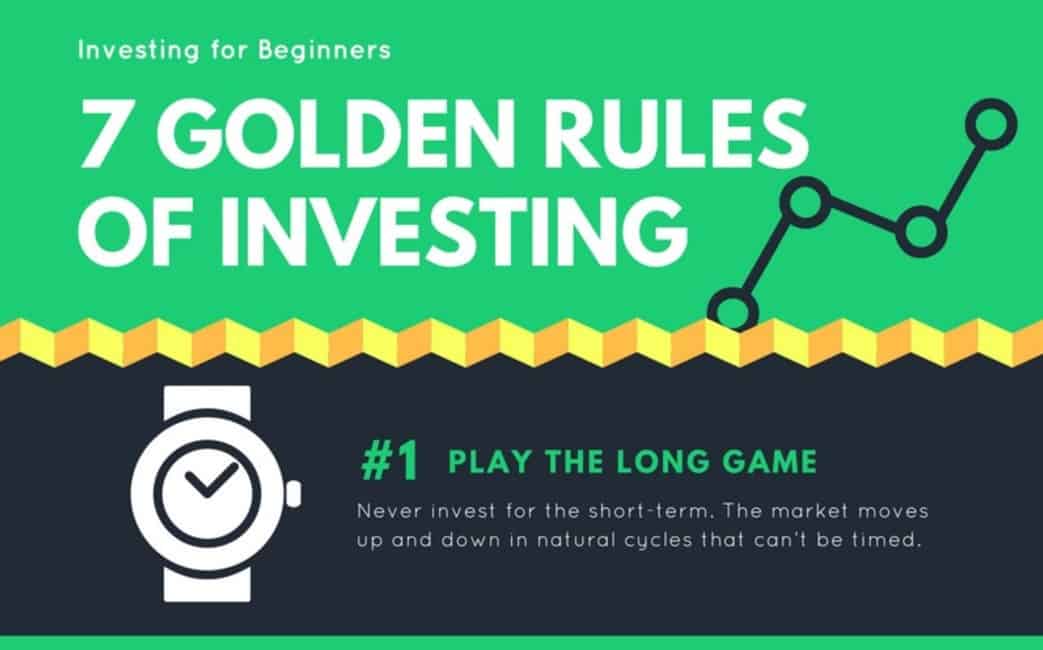
Click here to come across the whole infographic.
one. Play the long game
Never invest for the short-term. The market moves up and down in natural cycles that tin can't be timed. Investing for fewer than three to five years doesn't give you plenty time to rebuild asset value if you hitting a downturn at the wrong time.
2. Don't put all your eggs in one basket
Don't put too much of your coin in whatever ane stock or bail where one issue could destroy your wealth. Diversify with depression-toll, alphabetize ETFs and avoid stock picking.
3. Brand investing a monthly habit
Despite headlines continually calling a market top or lesser, no one tin can accurately make up one's mind where we are in the cycle at whatever given fourth dimension. The best way to guarantee that you lot purchase at the right times is to make investing a monthly addiction. Invest each and every month, regardless of headlines or market performance.
Related: How to Go Started Investing with $100
iv. Invest only what you lot tin afford to lose
Investing is risky. While the long-term tendency has historically been upward, there are too years of deep declines. If you need coin in the near-term, or the thought of seeing your account residue drop 20% makes you sick to your breadbasket, don't invest those funds.
five. Don't check your portfolio every 24-hour interval
Investing is the one identify where a "head in the sand" strategy might be the smartest method. Prepare up auto deposits into your investment accounts each month and just look at your portfolio in one case every three to six months. This reduces the likelihood of panic selling when the market falls or piling in more money when everything seems like rainbows and collywobbles.
half-dozen. Go on your fees depression
Common funds and ETFs have expense ratios. Many brokerages accuse trading fees. Investment providers from financial advisors to robo-advisors charge management fees. All these fees eat away at your wealth over time.
Sticking to index funds and ETFs keeps your fees low while guaranteeing you see the performance of the market then that you lot can continue more coin in your pocket.
7. Listen to Warren Buffet's investing advice
Warren Buffett is peradventure the most famous investor in history. He's created a multi-billion-dollar cyberspace worth in just 1 generation. Learn from his advice to invest for your own time to come.
"Someone is sitting in the shade today because someone planted a tree a long time ago."
"I never invest in anything I don't understand."
"If yous don't find a way to make coin while y'all slumber, you will work until you lot die."
"The stock market place is a device for transferring money from the impatient to the patient."
"It is not necessary to do extraordinary things to become extraordinary results."
How to Commencement Investing Today
An easy way to start investing today from your phone or laptop is by opening an account with Acorns, a micro-investing app platonic for beginner investors.
The basic plan, Acorns Invest, starts at just $1/month with a free $10 sign-upwards bonus for new users.
When yous make a purchase with a linked debit or credit bill of fare, Acorns rounds upwards to the nearest dollar and invests your spare change. You tin boost your Round-Ups by 2x, 5x, or 10x.
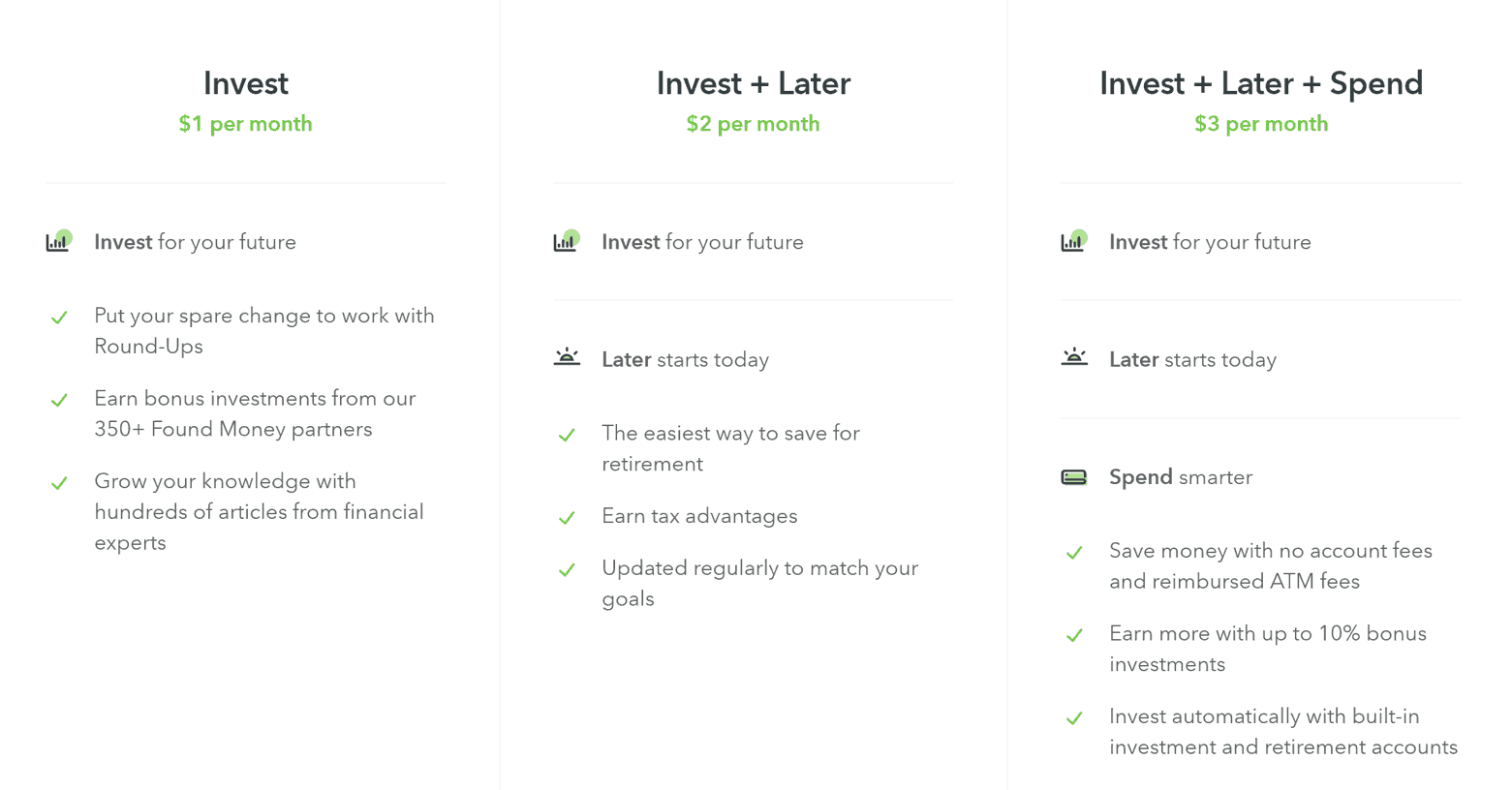
In add-on to Circular-Ups, you tin can ready up recurring daily, weekly, or monthly investments to your Acorns portfolio. Its Found Money service will also find cashback opportunities from 200+ partners and automatically invest your savings when you make a buy.
It just takes a few minutes to fix an account. One time you complete your profile, Acorns suggests one of its five portfolio options based on the information you provided. However, y'all have the option to override its proffer if you prefer a portfolio with more than or less risk.
The platform automatically rebalances your portfolio and reinvests all dividend payments to continue growing your investments.
Acorns is a smart option for hands-off investors and those just getting started. As your business relationship grows, the $one-iii monthly fee stays the aforementioned, finer making the service cheaper over fourth dimension.
DOWNLOAD HERE
Posted by: melendezpashe1943.blogspot.com